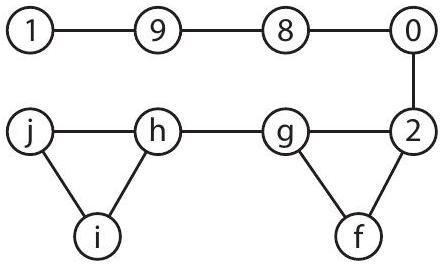
Sujet
On considère un graphe avec des chiffres dans les nœuds. A chaque nœud on fait correspondre la somme de ses voisins.
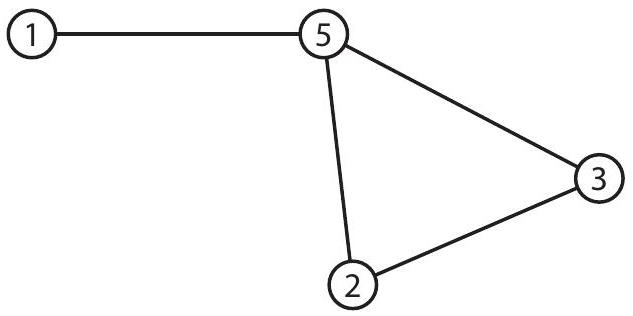
Par exemple :
Ici, 1 est associé avec 5;
5 est associé avec \(1+2+3=6\)
2 est associé avec \(5+3=8\)
Et 3 est associé avec \(2+5=7\).
On a mis les entiers de 0 à 9 dans le graphe suivant et associé à chaque nœud la somme de ses voisins. Malheureusement, presque tous les chiffres ont été effacés.
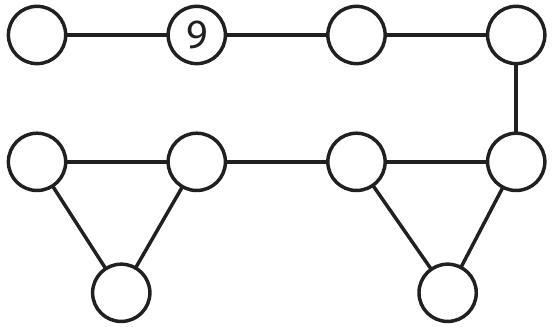
A vous de les retrouver sachant que :
\(0 \rightarrow 10\)
\(1 \rightarrow 9\)
\(2 \rightarrow 10\)
\(3 \rightarrow 9\)
\(4 \rightarrow 18\)
\(5 \rightarrow 10\)
\(6 \rightarrow 9\)
\(7 \rightarrow 9\)
\(8 \rightarrow 9\)
\(9 \rightarrow 9\)
La → signifie «est associé à ».
On introduit des noms pour les nœuds des graphes, que nous allons au fur et à mesure remplacer par les chiffres de 0 à 8 .
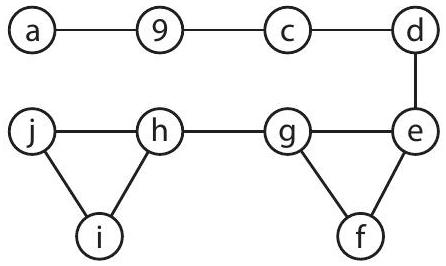
On a
\(\mathrm{a} \rightarrow 9\)
\(\mathrm{d} \rightarrow \mathrm{c}+\mathrm{e}\)
\(\mathrm{h} \rightarrow \mathrm{g}+\mathrm{i}+\mathrm{j}\)
\(9 \rightarrow \mathrm{a}+\mathrm{c}\)
\(\mathrm{e} \rightarrow \mathrm{d}+\mathrm{f}+\mathrm{g}\)
\(\mathrm{i} \rightarrow \mathrm{h}+\mathrm{j}\)
\(\mathrm{c} \rightarrow 9+\mathrm{d}\)
\(\mathrm{f} \rightarrow \mathrm{e}+\mathrm{g}\)
\(\mathrm{j} \rightarrow \mathrm{h}+\mathrm{i}\)
\(\mathrm{g} \rightarrow \mathrm{e}+\mathrm{f}+\mathrm{h}\)
Or \(9 \rightarrow 9\) et \(9 \rightarrow \mathrm{a}+\mathrm{c}\) donc \(\mathrm{a}+\mathrm{c}=9\) et alors \(\mathbf{c}=\mathbf{9}-\mathbf{a}\)
De plus, \(\mathrm{c} \rightarrow 9+\mathrm{d}\) avec \(0 \leqslant \mathrm{~d} \leqslant 8\); donc \(\mathrm{c} \rightarrow 9\) ou 10 car on ne peut pas atteindre les 18 ! Alors \(\mathbf{d}=\mathbf{0}\) ou 1.
Si \(\mathbf{d}=\mathbf{1}, \mathrm{c} \rightarrow 10\) donc \(\mathrm{c}=0,2\) ou 5 et \(\mathrm{d}=1 \rightarrow 9=\mathrm{c}+\mathrm{e}\). d'où \(\mathrm{c}=9-\mathrm{e}=9-\mathrm{a}\) donc \(\mathrm{a}=\mathrm{e}\). IMPOSSIBLE.
Donc \(\mathbf{d}=\mathbf{0}\).
Alors \(\mathrm{c} \rightarrow 9\) donc \(\mathbf{c}=\mathbf{1 , 3 , 6 , 7}\) ou 8.
Comme \(\mathrm{d}=0\) et \(0 \rightarrow 10, \mathbf{c}+\mathbf{e}=\mathbf{1 0}\) et \(\mathbf{c}+\mathbf{a}=\mathbf{9}\) donc \(\mathrm{e}-\mathrm{a}=1\) et \(\mathbf{e}=\mathbf{a}+\mathbf{1}\).
Alors pour le triplet ( \(\mathrm{a}, \mathrm{c}, \mathrm{e}\) ) on a comme possibilités :
\((1,8,2)\)
( \(2,7,3\) ) Impossible car \(2 \rightarrow 10\) et \(\mathrm{a} \rightarrow 9\) donc \(\mathrm{a} \neq 2\).
(3, 6, 4
) (4, 5, 5) Impossible car c = e
\((5,4,6)\) Impossible car \(\mathrm{a} \rightarrow 9\) et \(5 \rightarrow 10\) donc \(\mathrm{a} \neq 5\)
\((6,3,7)\)
Et (7,2,8) Impossible car \(\mathrm{c} \rightarrow 9\) et \(2 \rightarrow 10\) donc \(\mathrm{c} \neq 2\).
Il ne reste que 3 possibilités.
Testons le triplet ( \(1,8,2\) ) :