Sujet
Les pylônes
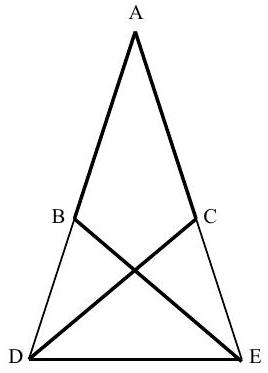
figure 1
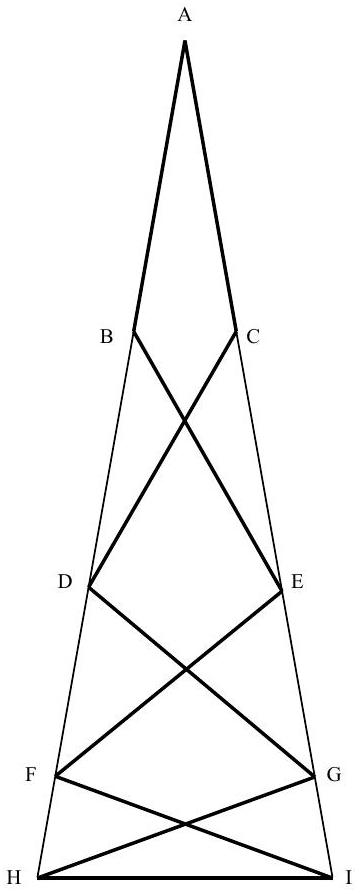
figure 2
- La figure 1 représente un pylône. Les poutrelles indiquées en gras sont toutes de même longueur : \(A B=A C=B E=C D=D E\). Calculer la mesure en degrés de l'angle \(\widehat{B A C}\).
- La figure 2 représente un autre pylône. Les poutrelles indiquées en gras sont également toutes de même longueur : \(A B=A C=B E=C D=E F=D G=G H=F I=H I\). Calculer la mesure en degrés de l'angle \(\widehat{B A C}\).
- Si on note \(\alpha\) une mesure en degrés de l'angle \(\widehat{B A C}\), en considerant les differents triangles isoceles et la propriete de la somme des angles dans un triangle, on obtient successivement : \(\widehat{A D C}=\alpha^{o} ; \widehat{A E B}=\alpha^{o} ; \widehat{A B E}=180^{o}-2 \alpha^{o} ; \widehat{D B E}=2 \alpha^{o} ; \widehat{B D E}=2 \alpha^{o}\) et \(\widehat{D E A}=2 \alpha^{o}\).
On a donc \(5 \alpha^{o}=180^{o}\) soit \(\alpha=36\)
L'angle \(\widehat{B A C}\) vaut \(36^{\circ}\).
2. La même démarche conduit a \(\widehat{B A C}=20^{\circ}\).